
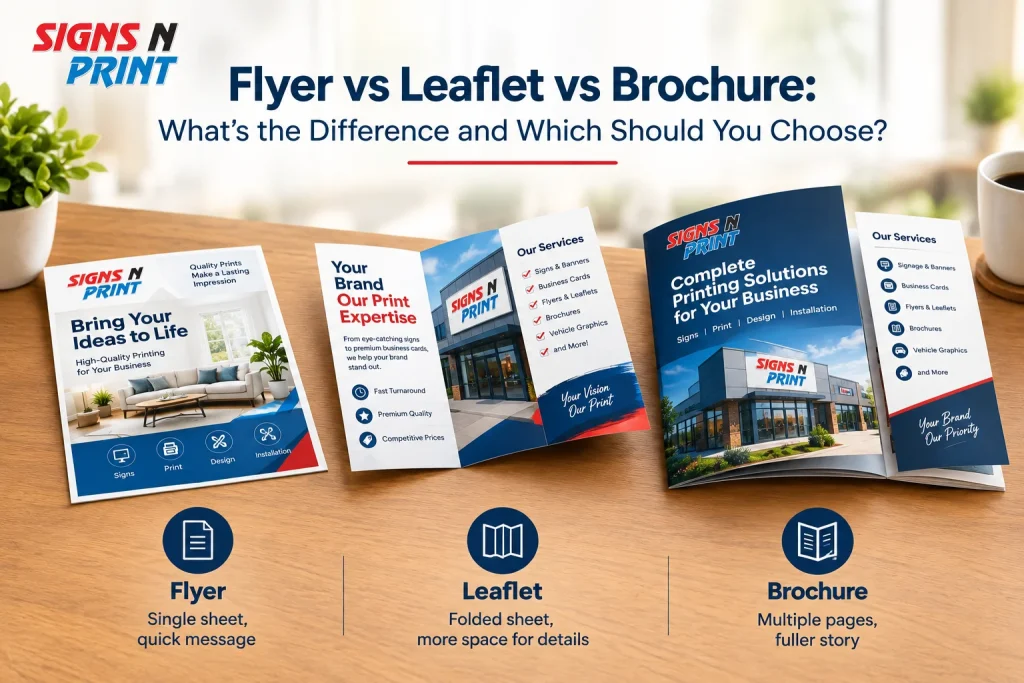
Flyer, leaflet, brochure. These three terms get swapped around constantly, but they are not the same: a flyer is usually a single flat printed sheet for a short message, a leaflet is often folded into panels to organise more information, and a brochure typically goes further with multiple panels or pages for detailed content. The flyer vs leaflet question is one of the main differences business owners and marketers need to understand before placing a print order or planning a campaign.
This article breaks down the format, information capacity, design, distribution, cost considerations and suitable use cases for all three types of printed materials so you can choose the right one for your next campaign, control print spend, and match the material to how your audience will read and respond.
Flyer vs Leaflet vs Brochure: Quick Answer
All three are types of printed marketing materials, but they differ in structure, depth and intended use. Here is a short answer before the full breakdown.
A flyer is a simple printed sheet designed to deliver a concise message. A leaflet is a printed sheet that may be flat or folded into panels, allowing more structured content. A brochure is a more information-rich piece, commonly using multiple pages or panels to present detailed information about a company’s products, services or offerings.
The key differences at a glance:
- Format: Flyers are flat single sheets; leaflets may be folded; brochures use multiple panels or pages.
- Information depth: Flyers carry a simple message; leaflets allow sections; brochures cover a single topic or offering in depth.
- Typical purpose: Flyers promote events or special offers; leaflets educate and provide information; brochures describe and persuade.
- Distribution: Flyers suit mass handouts; leaflets work in targeted drops; brochures serve as leave behinds at meetings and trade shows.
- Production: Flyers cost the least per unit; brochures cost the most due to paper, folding and binding.
Choose a flyer for a focused promotion or announcement. Choose a leaflet when you need a little more structured information. Choose a brochure when the reader needs detailed information before making a decision.
What Is a Flyer?
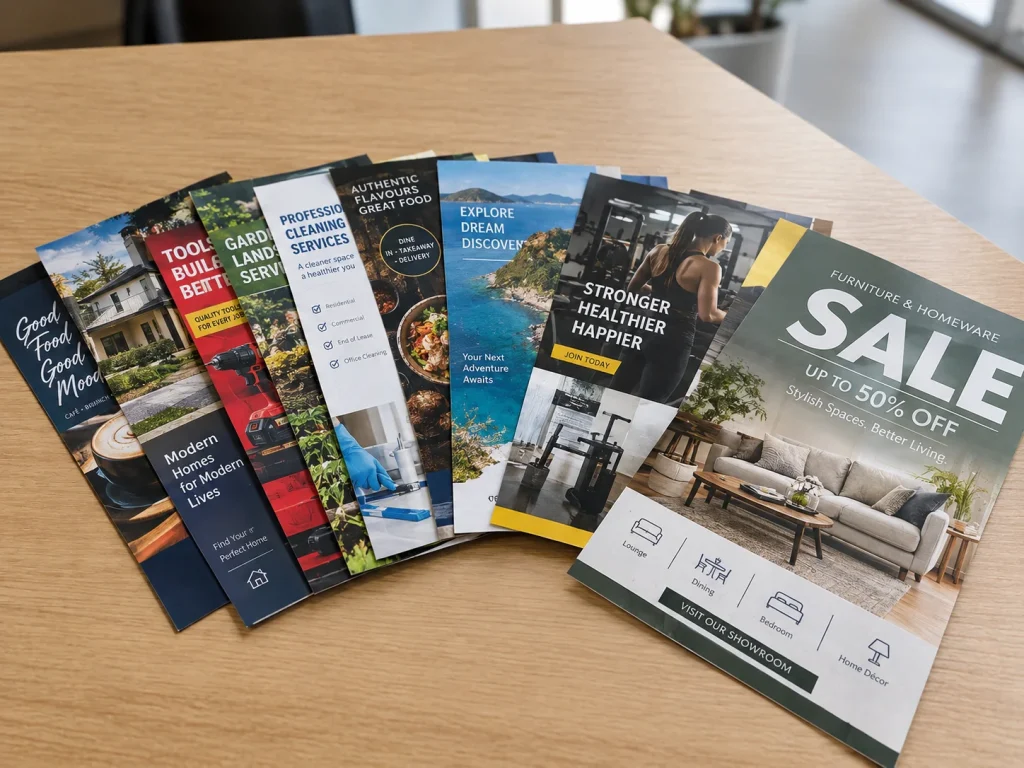
A flyer is a single sheet of paper, typically printed on one or both sides, built around one clear idea. Flyers are best for mass distribution and quick impact because the reader needs to understand the offer in seconds. Common Australian sizes include A6, DL, A5 and A4; for a full breakdown, see our guide to flyer sizes and print dimensions.
Flyers are used in different ways depending on the campaign, often for quick promotions or events such as:
- Grand openings and special offers
- Event promotion and coupons
- Local business announcements
- Package inserts
Distribution methods include letterbox drops, direct mail campaigns, counter handouts and event giveaways. Because flyers are typically single sheets of paper with minimal finishing, they are ideal for high-quantity, budget-conscious campaigns where the goal is broad awareness rather than in depth information.
What Is a Leaflet?
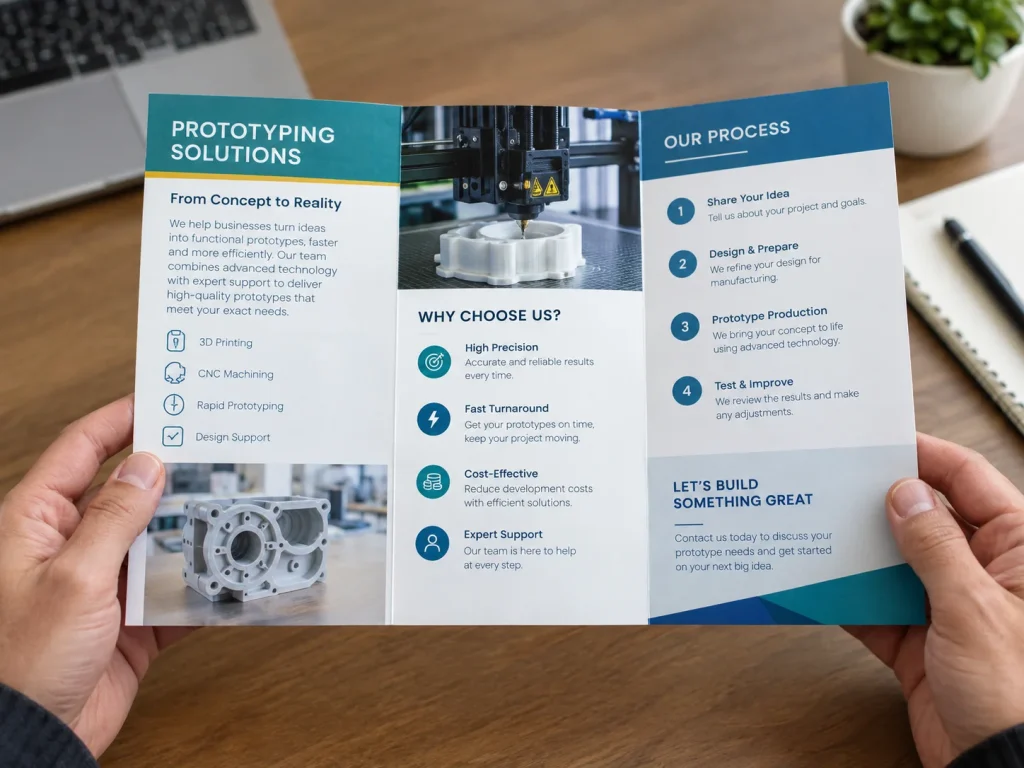
A leaflet is a printed sheet used to communicate information in a more structured format than a typical flyer. Where flyers and leaflets overlap is their starting point: both begin as a single sheet. The difference is that leaflets often include folds and provide more detailed information across distinct panels. Leaflets can have 2 to 36 printable sides depending on folds, which means a single A4 sheet folded into a tri-fold creates six readable panels without requiring binding or multiple sheets.
Common folded formats include:
- Bi-fold (4 panels)
- Tri-fold (6 panels)
- Gatefold
- Roll fold
Leaflets can be folded and contain more information than a flat flyer, making them suitable for menus, service information, product highlights, event programmes and local area guides. A leaflet works well when the message needs structure; for example, a restaurant can divide starters, mains and drinks across separate panels in a layout that helps keep the reader’s focus as they move through each panel. Leaflets are meant for informative content that is retained or referenced later, giving them a longer useful life than a disposable flyer.
What Is a Brochure?
A brochure is a printed marketing or information piece designed to present multiple sections of related content. Brochures usually contain 6 to 20 pages of information, though the format can range from a folded single sheet with several panels to a small booklet with perfect binding or saddle stitching.
Brochures are ideal for detailed storytelling and education. The extra space lets you include service details, features and specifications, pricing or packages, company information and supporting images. That depth makes brochures the better choice when a reader is already interested and needs enough material to compare options, outline a process or understand a complex service.
Common brochure applications include:
- Corporate capability documents
- Product or service presentations
- Real estate property marketing
- Travel and tourism information
Brochures function as high-value leave behinds at industry events, sales meetings and showrooms. If you need to create a brochure or flyer for an upcoming campaign, you can explore options on the Signs N Print flyers and brochures page.
Flyer vs Leaflet: Key Differences
The flyer vs leaflet question comes up because the two terms are used interchangeably in everyday conversation. In practice, the difference between flyer and leaflet comes down to structure, content depth and how long the reader holds onto the material.
Feature | Flyer | Leaflet |
Format | Flat single sheet, generally unfolded | Single sheet, may be folded into panels |
Content depth | Short, punchy, simple message | More detailed information across sections |
Paper | Often lower quality paper or lighter stock (130–150 gsm) | Often printed on heavier stock, scored for folding |
Lifespan | Read once, often discarded | Kept longer, referenced again |
Cost per unit | Lower; no folding or scoring required | Higher; folding, heavier material, more ink coverage |
Distribution | Mass handouts, letterbox drops, direct mail | Targeted drops, in-store racks, product inserts |
Flyers are generally less expensive to print than leaflets because they skip the folding and scoring steps and can use lighter paper. Leaflets serve to provide detailed explanations and are structured for deeper engagement, which is why customers tend to keep them rather than toss them.
Both flyers and leaflets are crucial tools for direct marketing strategies. The answer to “flyer or leaflet” depends on whether your audience needs a quick prompt or a structured overview.
Flyer vs Brochure: How They Compare
The difference between flyer and brochure is one of scale and intent. A flyer sticks to one focused promotion on a single sheet. A brochure has room to walk the reader through more: product features, pricing tiers, company background, spread across several pages or panels in an organised format.
Structural Differences
Structurally, flyers are one sheet with no folds (or a single fold at most). Brochures involve multiple panels or pages, often with folding, binding, or both. Brochures cost more due to heavier paper and folding; common paper weights for brochure cover stock range from 200 to 300 gsm, compared with 130 to 150 gsm for a typical flyer.
Cost and Usage
Flyers generally cost less to print than brochures, which makes them the go-to for high-volume distribution. Brochures carry higher perceived value and tend to stay on a client’s desk rather than in the bin. A practical approach is to combine both in a campaign: use flyers to advertise an event, drive foot traffic or direct people to a website, then hand brochures to anyone who wants the full story. At a trade show, for example, flyers attract passers-by while brochures close the conversation by answering detailed questions about your service.
Leaflet vs Brochure: When to Use Each
Leaflets sit between flyers and brochures in information density and cost. The difference between leaflet and brochure centres on how much material the reader needs and how long they will spend with it.
A leaflet is folded from a single sheet, creating panels. A brochure can span multiple pages with binding, UV coating or heavier cover stock. Leaflets are suitable for explaining complex services or products in detail when the scope fits within a few panels. Brochures handle larger narratives: company history, product line comparisons, case studies and supporting photography.
Consider a restaurant printing a takeaway menu. A tri fold leaflet covers starters, mains and drinks on six panels. A winery presenting its vineyard story, tasting notes, tour packages and booking form needs a booklet-style brochure with enough pages to do the subject justice.
When deciding leaflet or brochure, ask how much the reader needs to know before taking action. If the answer fits on a folded sheet, a leaflet works. If it requires multiple pages of images, comparison tables or in depth information, a brochure is the right call.
Choosing the Right Printed Material for Your Direct Mail Campaigns
Your marketing goals and audience determine the format. A few common scenarios, and the format that tends to fit each one:
- Trying to get people through the door for an event or sale? A flyer works best here: bold headline, the date and location front and centre, a clear call to action, handed out via letterbox drops or direct mail.
- Introducing a new service to the local area? Go with a leaflet: split the panels between an overview of the service, rough pricing and how to get in touch, then get it out via counters, public spaces or as a mail insert.
- Need to convince B2B buyers, or show up at an industry event? A brochure does the job: multiple pages covering specs, case studies and comparison tables, left behind after trade shows and sales meetings.
- Working with a tight budget but still want local awareness? Lean on flyers for the bulk of your run, and print a smaller batch of leaflets to hand to the prospects who want more detail.
A flyer that actually works usually has three things going for it: a strong headline, imagery that catches the eye, and a clear call to action. Leaflets are designed for more detailed information delivery, making them the better format when the reader wants to compare two options or understand a process. Mixing different formats within one campaign lets you cover both broad reach and focused persuasion.
According to the Data & Marketing Association, printed direct mail generates a 4.4% response rate compared with roughly 0.12% for email. Choosing the right printed material can make that response rate count.
Design, Paper and Print: Presenting Flyers, Leaflets and Brochures Professionally
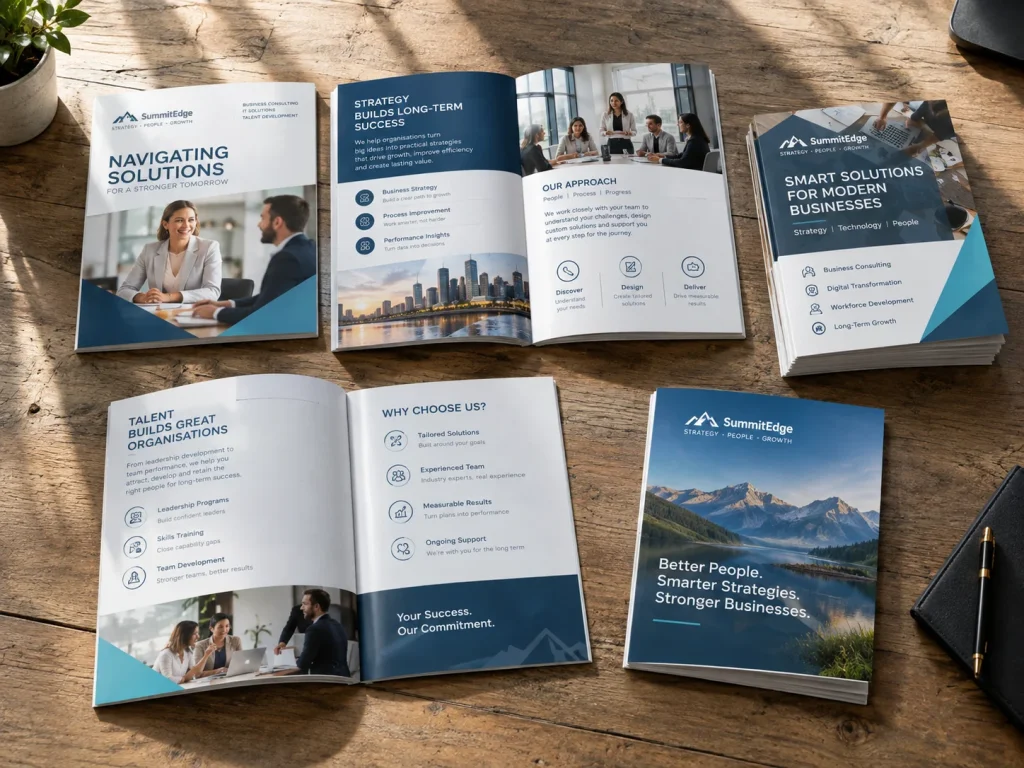
Paper stock and finishing change how any printed piece feels in the reader’s hand. Leaflets are often printed on heavier stock and designed to feel more substantial than a flyer, which helps the reader treat the material as worth keeping. Brochures typically use even heavier cover stock (200–300 gsm) and may include finishing such as UV coating, gloss or matte lamination.
For flyers intended for mass distribution, lighter stock (130–150 gsm) keeps cost and weight down, which matters for direct mail campaigns where postage is calculated by weight. A half letter or DL-sized flyer fits a standard envelope without extra postage. Brochures and multi-panel leaflets may exceed standard envelope dimensions, so factor mailing requirements into your format decision early.
Design should match how the material will be read. Flyers need a clear visual hierarchy because the reader scans in seconds. Leaflets work best when the layout carries the reader panel by panel through each section. Brochures can afford more photography, charts and copy per page, simply because the reader has already decided to spend time with the piece. Whatever format you choose, keep branding consistent across all your business printing to reinforce recognition.
Ready to Print? Let Signs N Print Help You Choose
Signs N Print handles signage and printing across all three formats: single-sheet flyers, folded leaflets and multi-page brochures. Promoting an event, introducing customers to a new service, or putting together a booklet for a client meeting, whatever it is, getting the format and paper right makes all the difference.
If you are ready to discuss your next print project or want help choosing between a flyer, leaflet or brochure, contact Signs N Print to get started.