
Your Ultimate Guide To Posters: Sizes, Types, and Budgets
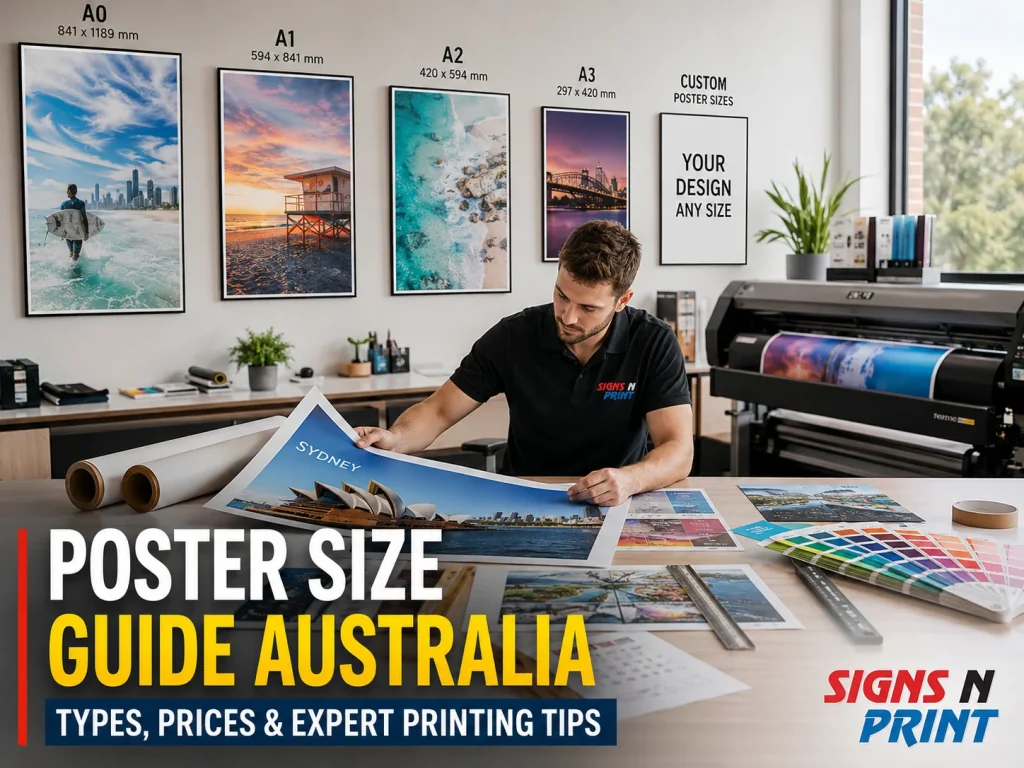
Posters still do one job very well: they get seen fast. In Australia, the most common poster formats sit inside the A-series system, with A0, A1, A2, A3 and A4. These are used across retail, events, offices and general advertising.
In this blog, we are going to break down the most common poster sizes, types, and materials. We will also look at budget-friendly poster printing options. So let’s begin.
Standard Poster Size Dimension
The A-series is the backbone of poster printing in Australia. A0 sits at 841 × 1189 mm, A1 at 594 × 841 mm, A2 at 420 × 594 mm, A3 at 297 × 420 mm and A4 at 210 × 297 mm.
A3 and A4 work when someone is already standing close. A2 gives breathing room for a message and an image. A1 starts to command a space. A0 is the one you choose when you need the poster to cover the room.
| Size | Dimensions | Best Use | Budget |
| A4 | 210 × 297 mm | Small notices, menus, price lists, close-up reading | Lowest entry cost |
| A3 | 297 × 420 mm | In-store signs, local promos, simple announcements | Cheap and practical |
| A2 | 420 × 594 mm | Retail windows, event posters, mid-distance display | Strong mid-range choice |
| A1 | 594 × 841 mm | Big promotions, exhibitions, concerts, and higher-traffic areas | Higher impact, higher cost |
| A0 | 841 × 1189 mm | Large campaigns, street posters, public-facing advertising | Premium large-format option |
Signs N Print offers custom dimensions if the standard sizes do not suit your wall, frame or campaign layout.
2026 Poster Prices in Australia
In Australia, poster printing starts at about $49 for 25 A3 posters, around $169 for A2, roughly $550 for A1, and about $660 for A0 when you are paying for print only.
Remember that if you add distribution, lamination, mounting, or rush turnaround, the total amount will become higher.
A3 and A4 are the budget-friendly picks for notices and simple promos, A2 is the sweet spot for stronger visibility without a big price jump, and A1/A0 belong in the higher-impact bracket where the poster is doing the heavy lifting.
So in a nutshell, the more space, finish, and speed you ask for, the more you will have to pay.
Types of Posters
Promotional Posters
Promotional posters are best for sales, launches, special offers, and limited-time deals. These posters need one clear headline, one strong image, and a simple call to action. Too much text kills the impact.
Event Posters
Event posters are best for concerts, seminars, festivals, fundraisers, and business events. The key details have to stand out: date, time, venue, and ticket or entry info. The design should feel energetic and match the mood of the event.
Informational Posters
Used in workplaces, schools, clinics, and public spaces where the goal is to explain something quickly. These posters work best when the message is direct, the layout is clean, and the reading path is obvious.
Brand Posters
Brand posters are used in offices, retail spaces, and waiting areas to build recognition over time. The visual identity does most of the talking.
Decorative Posters
Made for homes, studios, and offices where the image itself is the main feature. Here, style matters more than selling. The poster should look good in the room and suit the space it is going into.
Outdoor And Street-Style Posters
These need tougher stock and a smarter finish. They get handled more, exposed more, and often need to survive weather, glare, or constant movement around them. Laminated, mounted, waterproof, synthetic, or large-format options make more sense here because durability matters just as much as design.
Poster Materials and Finishes
Poster stock changes the whole feel of the job. Light paper works for short runs, indoor notices, and posters that do not need to last long. Heavier stock feels more solid, holds colour better, and gives the poster a cleaner, more premium finish.
Here are some common stock choices:
- 160gsm coated paper
Good for basic posters, quick promotions, and everyday indoor use. - 200gsm gloss or satin paper
A stronger option when you want better colour and a more polished look. - 250gsm satin poster paper
Better for posters that need to look sharper and hold up better in display. - Synthetic stock
Best when the poster needs extra durability, moisture resistance, or longer life.
Tips to Choose the Right Poster
Here is the practical checklist worth using before printing:
- Keep the main message short and obvious.
- Use a size that matches the viewing distance.
- Choose gloss, matte or satin based on light and glare.
- Use high-resolution artwork, ideally 300dpi, so the final print stays crisp.
- Pick synthetic, laminated or mounted stock when the poster needs more life.
- Allow for turnaround time if the job is urgent. Same-day or next-day services exist, but only when artwork is ready, and production capacity allows it.
Get High-Quality Posters Printed With Signs N Print
If you are looking for professional posters tailored to your campaign, Signs N Print can help with everything from posters and banners to signage and wider print needs.
For a custom quote or print advice, our team is ready to help you and bring your poster idea to life with quality and convenience.
Contact Us and Get a Quote Now.